
Losing volume or firmness since starting a GLP-1?
Quick answer: If you're taking a GLP-1, you may notice your face losing volume, often called "Ozempic face." It happens because fat, muscle, and support beneath the skin change faster than skin can adapt. The right approach depends on which one you're dealing with: skin laxity, where the face sags, or facial deflation, where it hollows.
Key takeaways
Your face thins along with the rest of your body.
Three layers change at once: bone, fat, and muscle.
Skin laxity and facial deflation are separate concerns, each treated with a different approach.
A thorough consultation at the right point means restoring your natural volume rather than overcorrecting a face that is still changing.
Early research suggests getting ahead of the volume loss may work better than repairing it afterward.
What is Ozempic face?
Losing weight almost always costs you some volume in your face. What's different with GLP-1 medications like Ozempic, Wegovy, Zepbound, and Mounjaro is the speed. The weight comes off faster than your skin can adapt, which is why facial deflation shows up so noticeably. That's what people mean by "Ozempic face."
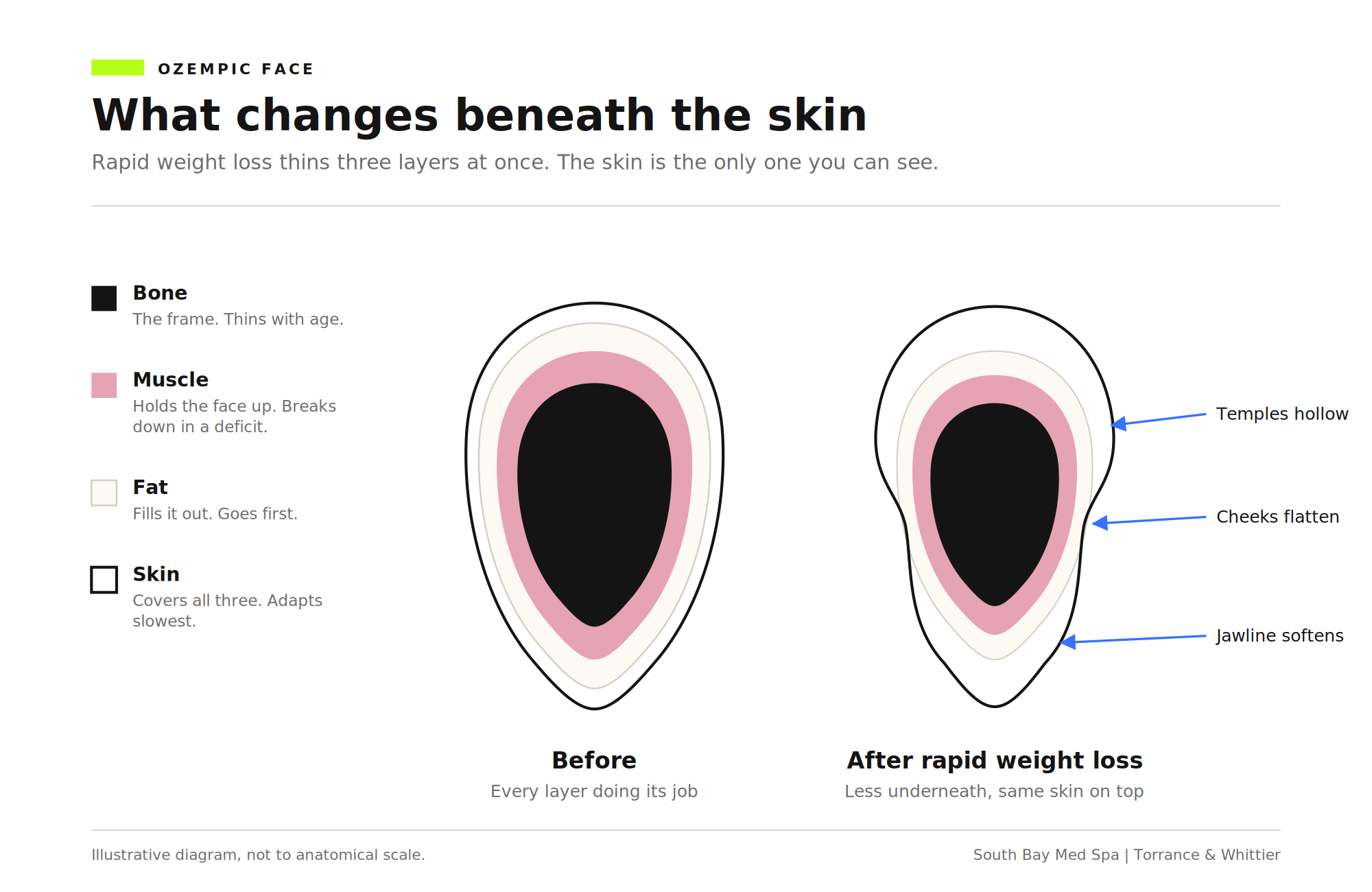
Diagram comparing facial structure before and after rapid GLP-1 weight loss, showing thinning of the bone, muscle, and fat layers beneath the skin.
What changes?
Bone thins with age, softening the jawline and cheekbones. Fat pockets shrink, and the shadows on your face change. Muscle breaks down when you are eating much less, and that muscle is part of what holds your face up.
How we approach it in the office
We start by asking where you are in your weight loss and where you're headed, then look at whether you're seeing skin laxity, facial deflation, or both, which tells us what to treat now, what to wait on, and in what order rather than doing everything in one visit.
When the problem is loose skin
Energy-based treatments heat the deeper layers of skin, which makes existing collagen contract immediately and prompts new collagen over the months that follow.
We use radiofrequency microneedling (Morpheus8), which delivers heat just below the surface through very fine needles. This lets us treat firmness and skin texture in the same session.
Tightening takes a series of visits, with results building over three to six months. That's a similar timeline to collagen stimulators, which is why we often pair the two (more on those below).
One honest limit. Tightening treatments are well-suited to mild to moderate laxity. If the skin is genuinely loose and hanging, no device can match what surgery does, and we will tell you that rather than sell you a package that will not get you there.
Collagen stimulators, and why we use them
These are our workhorses for this problem, and they work differently from a standard filler.
A regular filler adds volume by taking up space. A collagen stimulator such as Radiesse or Sculptra does something else. It prompts your own body to build new support tissue over the following months. You are not just filling a hollow area; you are rebuilding some of what was lost. That slower timeline is a feature, not a drawback, especially when your weight is still moving.
Collagen stimulators work particularly well along the jawline and cheeks, which is exactly where GLP-1 patients tend to lose definition first. They can also be diluted and spread over a broader area when the concern is skin quality rather than a specific hollowed area, which is a good option for the jawline or neck that has gone soft and crepey but does not need volume added.
How much we use, where we place it, and how we dilute it depends on where you are losing volume, how fast, and what you want your timeline to look like. We determine that together at your consultation.
Radiesse collagen stimulator treatment for Ozempic face at South Bay Med Spa, Torrance and Whittier, CA
What the research shows so far. What the research shows. Early studies on both products are encouraging. Patients treated with hyperdilute Radiesse maintained their facial measurements over six months rather than continuing to decline, and a Galderma trial pairing Sculptra with a hyaluronic acid filler showed improvements in contour and skin quality that still held at nine months. Both studies are small, and neither had a comparison group, but they point in the same direction.
Bryan Johnson documented the same facial changes and what he did about them. Worth noting he wasn't on a GLP-1. His volume loss came from years of aggressive caloric restriction, which is a useful reminder that it's the speed of the loss doing this, not the medication.
Bryan Johnson, "I Tried To Make My Face Younger." Starts at his collagen stimulation section.
Hyaluronic acid fillers
Hyaluronic acid fillers do the opposite of a stimulator. They add volume immediately, right where we place it. That makes them the better choice when an area has emptied enough that waiting several months is not practical, particularly cheeks and temples that have gone flat or scooped. Juvederm, Restylane, the RHA collection, and Revanesse Versa all fall into this category, and they behave slightly differently from one another.
We often pair a filler with a stimulator. The filler fills the hollow you can see today, and the stimulator prompts your body to build its own support over the following months. Fillers are also reversible, which matters more than usual when your weight is still moving.
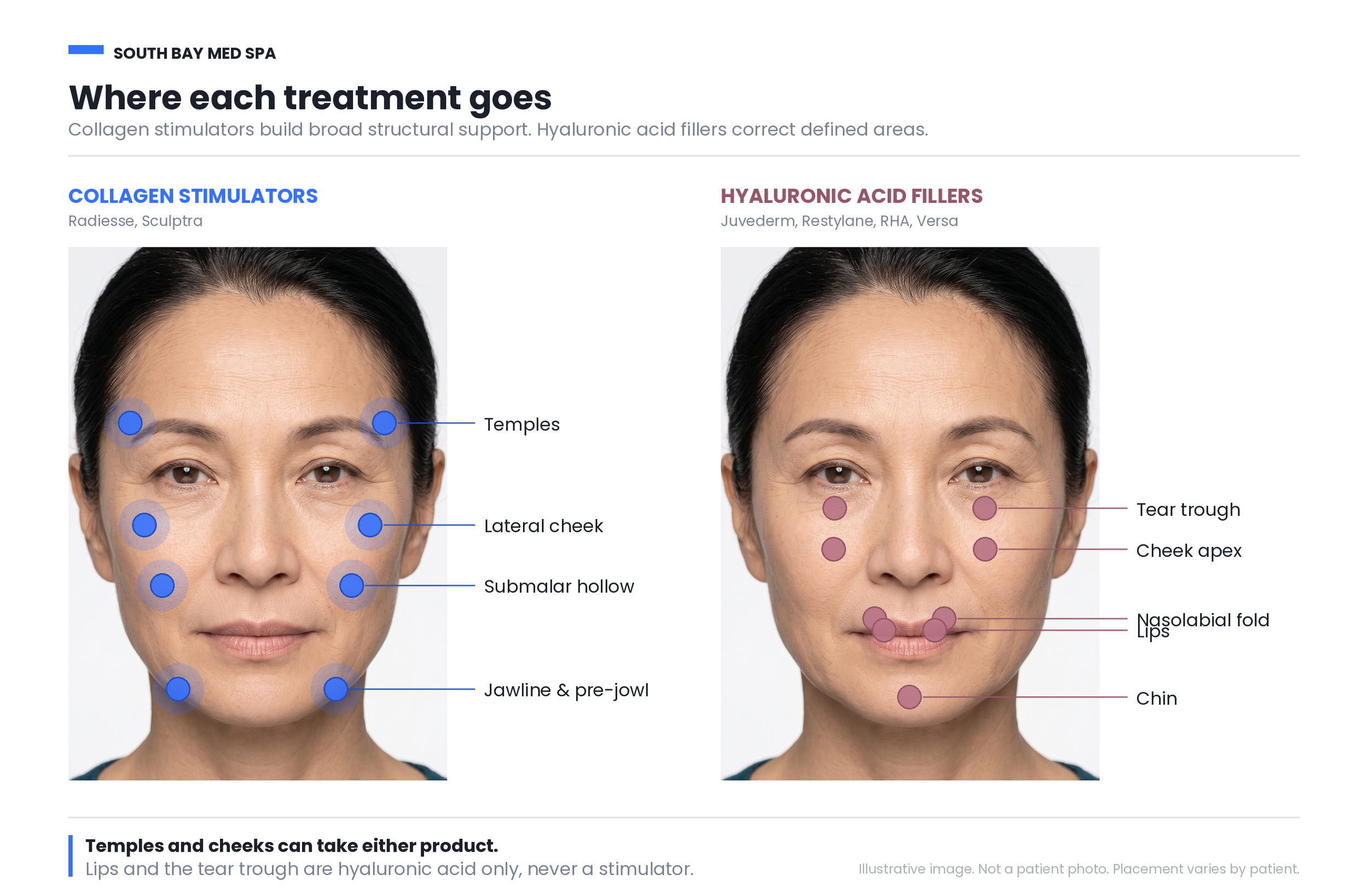
Where each treatment goes. Stimulators build broad structural support; fillers correct defined areas.
When to treat, and when to wait
When you catch yourself in the mirror, and it seems like your face has lost volume overnight, the urge is to fix it right now. But chasing a moving target can lead to unwanted outcomes, like looking overfilled or unbalanced. Anything permanent, surgery especially, should wait until your weight has settled.
That does not mean we do nothing in the meantime. We build a plan and work in stages. As a rough guide, every ten to fifteen pounds is enough to change how your face looks, so we check in at intervals rather than reacting to every shift.
Small steps that keep pace with where you actually are will always beat one big correction aimed at a face that is still in motion.
Frequently Asked Questions
-
Patients ask us whether being on a GLP-1 changes how these work. It does not. There is no chemical interaction between these medications and neurotoxin or filler. What changes is the face underneath the treatment, so placement and dosing may need to shift as you go. That is a reason to keep checking in, not a reason to wait.
-
It depends on what you are considering. Anything permanent should wait until results are achieved. Treatments that are reversible or that work gradually can start earlier, and the early evidence suggests getting ahead of the change may work better than repairing it afterward.
-
No. Filler stays where we place it and does not break down faster because you are losing weight. What changes is the face around it, which is why we place conservatively and look at you again in a few months rather than doing everything at once.
-
Returning fat doesn't always come back to the same places in the same proportions, and it doesn't rebuild the structure you lost. Anything we've placed stays put, so an unexpected change in weight can leave you fuller than planned. It's manageable, and it's a good reason to keep checking in rather than treating it all at once and calling it done.
-
It varies by product, by area, and by person, but typically 8 to 18 months.
-
Most treatments range from $500 to $1,500, depending on how many syringes you need. You'll get a plan and a number at your consultation, before you commit to anything.
-
For injectables, expect some swelling and the possibility of bruising for a few days. Most people go back to normal activity the same day. Energy-based treatments leave the skin red and warm for a bit longer. If you have an event coming up, tell us, and we will plan around it.
-
That is exactly what a careful consultation is meant to prevent. If it's a concern, tell us, and we'll take a conservative approach and build from there.
-
The neck matters as much as the face. We treat it by stimulating collagen, using microneedling, Morpheus8, or fractional CO2, and collagen stimulators are an option here as well. Hyperdilute Radiesse or Sculptura spread thin across a broader area improves firmness and skin quality rather than adding volume, which is usually what a neck actually needs.
-
Shedding is common with rapid weight loss, and it usually has more to do with the speed of the loss and reduced nutritional intake than with the medication itself. The reassuring part is that this kind of shedding is typically temporary. It tends to settle on its own once your weight and your nutrition stabilize.
If it is dragging on, or you want to support regrowth while you wait, there are options. PRP uses a concentrated portion of your own blood, injected into the scalp, to stimulate the follicles, and it is one of the more common non-surgical approaches for thinning hair. A course of six treatments ranges from $1,500 to $1,800. Topical minoxidil and supplements such as Nutrafol are also worth asking about.
They work differently from each other, so which one fits depends on what is actually driving the thinning.
Schedule a consultation in Torrance or Whittier
If you're on a GLP-1 and your face has changed, come in for a complimentary consultation. We'll tell you what we see and what we'd recommend, including whether it's better to wait.