
Does PRP Actually Work for Hair Loss? Here's What the Research Says
Hair loss used to be a hard conversation. For years, the only options we could offer were minoxidil or a referral for a hair transplant, so patients who were somewhere in between (thinning but not bald) were often told to wait and see.
PRP changed that conversation. But it's also surrounded by claims that range from modest to unbelievable, so let's look at what the research actually shows and where we set expectations in the room.
What PRP is
PRP stands for platelet-rich plasma. We draw a small amount of your blood, spin it in a centrifuge to concentrate the platelets, and inject that plasma into the thinning areas of your scalp. Platelets carry growth factors, and those growth factors act on the stem cells in your hair follicles, waking up dormant follicles and encouraging new blood vessel growth around them.
Nothing foreign goes in. It all comes from you.
What the studies show
The study we point patients to is a randomized, placebo-controlled trial published in Stem Cells Translational Medicine, which you can read for yourself on the National Library of Medicine's database. Patients received PRP on one half of the scalp and placebo on the other, with three treatments spaced a month apart. After those three sessions, the treated side gained an average of 33.6 hairs and total hair density rose by 45.9 hairs per square centimeter, while the placebo side actually lost a small amount. The most meaningful part is that the gains were in terminal hairs, the thicker ones, rather than fine vellus hair.
That isn't one isolated result. A meta-analysis of 11 studies covering 262 patients found a significant increase in hair count per square centimeter after PRP compared with control groups. A larger review of 30 studies and 687 patients found that 29 reported beneficial results, with 24 reaching statistical significance.
What we tell patients it won't do
PRP improves density. It does not bring back hair where the follicles are already gone. If an area has been completely bare for years, there's nothing left for the growth factors to work on, and we'll tell you that rather than sell you a series.
It also isn't permanent. In that same trial, researchers noted the effect declines by roughly 14 months after the last treatment, and several patients saw thinning return around the 12-month mark and came back for another round. That's why we recommend maintenance every 6 to 12 months.
PRP is not FDA-approved for hair loss. The only FDA-approved drug treatments are minoxidil and finasteride. PRP is a procedure using your own blood, which the FDA regulates differently. We bring this up because you deserve to hear it from us rather than find it later and wonder what else wasn't mentioned.
PRP or a transplant?
This is the question we get most, and the answer usually comes down to one thing: is the follicle still there? Book a Consultation.
PRP works on follicles that are alive but shrinking. The hair is getting finer, the part is widening, the coverage is thinning, but there's still something to stimulate. That's where growth factors can make a real difference.
A transplant is for areas where the follicles are gone. Once a follicle has died, no injection brings it back, and surgery is the honest answer. A surgeon moves follicles from the back and sides of your head, which are genetically resistant to the hormone that causes pattern loss, up to the areas that need them.
They treat different stages of the same problem, and plenty of people eventually do both. If you're on the line, that's exactly what a consultation is for. I'll look at your scalp and tell you which side of it you're on, even if the answer is that you'd be better served by a surgeon than by us.
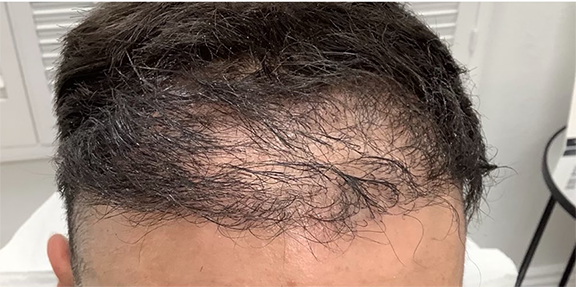
Before PRP Hair Treatment
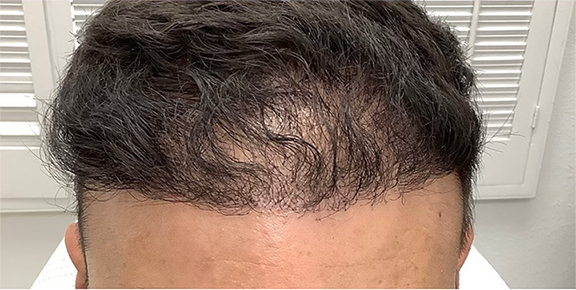
After PRP Hair Treatment
One session a month for five months, then maintenance. Each visit takes under an hour: blood draw, spin, numbing, injections. There's no downtime, and most patients head straight back to their day. Results build gradually, and most people start noticing a difference around three months in.
If you're noticing thinning and want to know whether PRP is right for you, book a consultation and we'll take a look together.